Creatinine (Serum creatinine, Blood creatinine, Plasma creatinine, SCr, Cr, Creat)
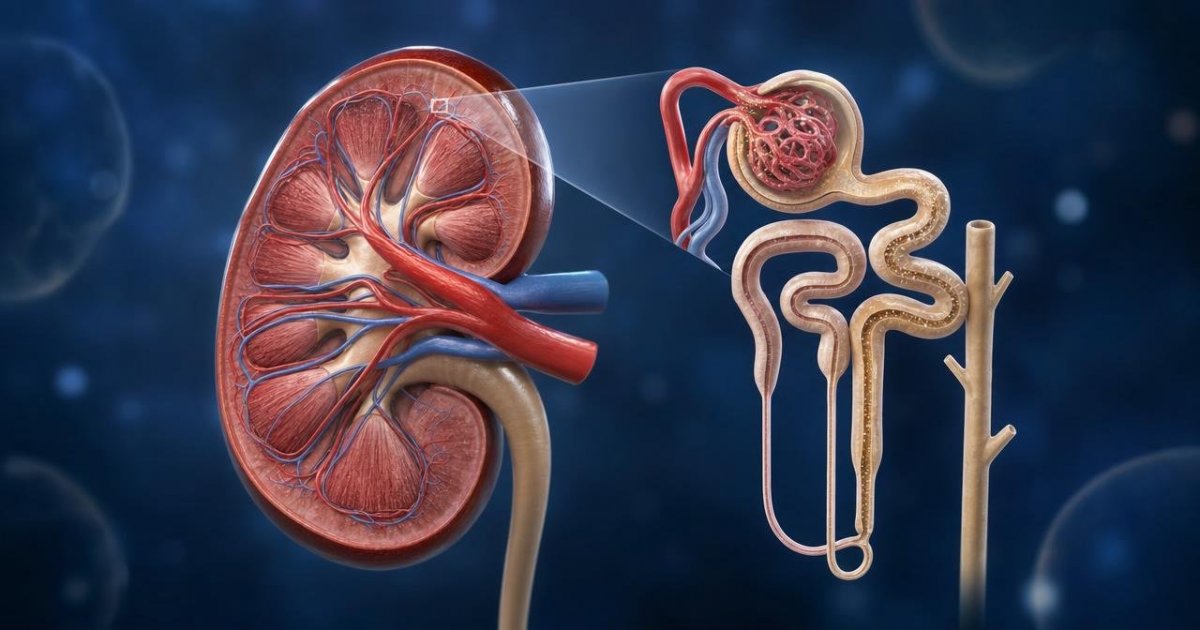
Creatinine is a waste product your body makes around the clock. Muscles use a compound called creatine for quick energy, and as they do, a small, steady fraction breaks down into creatinine. It has no job to do — it is simply debris — and healthy kidneys filter it out of the blood and send it into urine almost as fast as it is made. That steady production and steady removal are exactly what make it useful: when kidney filtering slows down, creatinine has nowhere to go and its level in the blood climbs. That is why a simple creatinine test, drawn with routine blood work, has been the everyday window into kidney function for decades.
The catch is that creatinine depends on how much muscle you have, not just on your kidneys. A muscular 25-year-old man naturally runs higher than a petite 70-year-old woman even when both have perfectly healthy kidneys. Labs handle this by reporting sex-specific reference ranges — roughly 0.7 to 1.3 mg/dL for adult men and 0.6 to 1.1 mg/dL for adult women in the US — and by calculating an eGFR, which folds your age and sex into an estimate of actual filtering power. When you look at your result, the creatinine number, the eGFR, and how both compare to your own past values together tell the real story.
Reference ranges
Men
The typical adult male reference range is about 0.7 to 1.3 mg/dL (62 to 115 µmol/L), following the convention used by most US laboratories.
| Range (mg/dL) | Classification |
|---|---|
| 0.2–0.7 | Low |
| 0.7–1.3 | Normal |
| 1.3–1.5 | Borderline high |
| 1.5–2 | High |
| 2–5 | Very high |
| 5–7.4 | Severely high |
| 7.4–10 | Critical high |
Women
The typical adult female reference range is about 0.6 to 1.1 mg/dL (53 to 97 µmol/L), the convention used by many US laboratories; some references cite slightly lower limits (for example, Mayo Clinic lists 0.59 to 1.04 mg/dL).
How to read your result
High creatinine gets the attention, and reasonably so: a rising level usually means the kidneys are filtering less, whether from a temporary insult like dehydration or medication, a blockage in the urinary tract, or chronic kidney disease. But context is everything. A mildly elevated result in a muscular man who trains hard and takes creatine may be completely benign, while the same number in a small older woman can represent meaningful loss of function. New elevations matter more than stable ones — a jump from your usual baseline deserves quicker follow-up than a value that has read the same for years.
Low creatinine rarely signals danger. It typically reflects less muscle mass — smaller build, older age, or deconditioning — and in pregnancy it is expected, because blood volume expands and the kidneys actually filter faster. Only occasionally does a low value hint at malnutrition, liver disease, or a muscle-wasting condition, and usually there are other symptoms pointing the same way. In short: read high results against your baseline and your eGFR, read low results against your body build and life stage, and let the trend over time carry more weight than any single number.
What can shift this value
- Muscle mass and body size — more muscle means more creatinine, independent of kidney health
- Hydration — dehydration concentrates the blood and raises creatinine temporarily
- A large cooked-meat meal within several hours of the blood draw
- Creatine supplements, popular with gym-goers
- Intense exercise in the 24–48 hours before testing
- Medications — NSAIDs, ACE inhibitors, ARBs, and diuretics can reduce kidney filtration, while trimethoprim and cimetidine raise creatinine without actually harming the kidneys
- Pregnancy — expanded blood volume and faster filtration lower creatinine, so 'normal-looking' values can actually be high for pregnancy
- Age — muscle loss lowers creatinine production even as kidney function also gradually declines, which can mask changes
- Amputation or muscle-wasting illness, which lowers the baseline
- Lab methodology — Jaffe versus enzymatic assays can differ slightly, so small shifts between labs may not be real
When it's tested
Creatinine is included in the basic metabolic panel (BMP), the comprehensive metabolic panel (CMP), and the renal function panel — so it appears in most routine annual blood work, usually right alongside BUN (blood urea nitrogen) and an automatically calculated eGFR. Doctors also order it before CT scans or procedures using contrast dye, before starting or adjusting medications that pass through the kidneys (such as metformin, certain antibiotics, and chemotherapy), during hospital stays to watch for acute kidney injury, and at regular intervals to track chronic kidney disease.
US labs report creatinine in mg/dL, while labs in the UK, Singapore, and most other countries report µmol/L — multiply mg/dL by 88.4 to convert (so 1.0 mg/dL is about 88 µmol/L).
Frequently asked questions
Is your value a normal creatinine level?
For adults, most US labs consider about 0.7 to 1.3 mg/dL normal for men and 0.6 to 1.1 mg/dL normal for women. Where your value falls depends on your sex, your muscle mass, and your lab's specific range, so always compare against the reference range printed on your own report.
What does a creatinine of your value mean for my kidneys?
Creatinine is a muscle waste product your kidneys filter out, so the level in your blood is an indirect gauge of kidney filtering power. Higher usually means slower filtration; lower usually means less muscle making it. The eGFR on your report translates your creatinine into an estimated filtration rate, which is the number kidney specialists actually track.
Can drinking more water lower my creatinine?
A little, and only if you were dehydrated to begin with. Dehydration concentrates the blood and temporarily raises creatinine, so rehydrating can bring a mildly elevated value back to your true baseline. But water does not repair kidney function — if your creatinine stays high when you are well hydrated, the kidneys themselves need evaluating. Don't force extreme amounts of water; normal, steady hydration is the goal, and persistent elevations belong in a conversation with your doctor.
Why is the normal creatinine range different for men and women?
Creatinine is produced by muscle, and men on average carry more muscle mass than women, so men naturally make more of it. That is why US labs typically use about 0.7–1.3 mg/dL for men and 0.6–1.1 mg/dL for women. It also means the same number can carry different weight: a creatinine of 1.2 is unremarkable in most men but slightly above range for most women. The eGFR calculation builds in your sex and age to correct for this.
What is eGFR and why does it matter more than creatinine alone?
eGFR (estimated glomerular filtration rate) is a calculation that converts your creatinine, age, and sex into an estimate of how many milliliters of blood your kidneys filter per minute. It matters because the same creatinine means different things in different people — 1.3 mg/dL could be normal for a muscular 25-year-old man yet signal real disease in a slight 78-year-old woman. An eGFR of 90 or higher is generally normal; below 60 for three months or more defines chronic kidney disease. Ask your doctor to walk you through both numbers together.
Can creatine supplements or eating meat raise creatinine?
Yes, both can. Creatine supplements convert to creatinine and can nudge blood levels up without any harm to the kidneys, and a large serving of cooked meat within several hours of a blood draw does the same, because cooking converts the creatine in meat into creatinine. Intense workouts in the day or two before a test add to the effect. If a mildly high result might be explained this way, tell your doctor about your supplements and diet, and repeat the test after skipping creatine and heavy meat meals for a couple of days beforehand.
Browse Creatinine values
All 99 values from 0.2 to 10 mg/dL
- 0.2
- 0.3
- 0.4
- 0.5
- 0.6
- 0.7
- 0.8
- 0.9
- 1.0
- 1.1
- 1.2
- 1.3
- 1.4
- 1.5
- 1.6
- 1.7
- 1.8
- 1.9
- 2.0
- 2.1
- 2.2
- 2.3
- 2.4
- 2.5
- 2.6
- 2.7
- 2.8
- 2.9
- 3.0
- 3.1
- 3.2
- 3.3
- 3.4
- 3.5
- 3.6
- 3.7
- 3.8
- 3.9
- 4.0
- 4.1
- 4.2
- 4.3
- 4.4
- 4.5
- 4.6
- 4.7
- 4.8
- 4.9
- 5.0
- 5.1
- 5.2
- 5.3
- 5.4
- 5.5
- 5.6
- 5.7
- 5.8
- 5.9
- 6.0
- 6.1
- 6.2
- 6.3
- 6.4
- 6.5
- 6.6
- 6.7
- 6.8
- 6.9
- 7.0
- 7.1
- 7.2
- 7.3
- 7.4
- 7.5
- 7.6
- 7.7
- 7.8
- 7.9
- 8.0
- 8.1
- 8.2
- 8.3
- 8.4
- 8.5
- 8.6
- 8.7
- 8.8
- 8.9
- 9.0
- 9.1
- 9.2
- 9.3
- 9.4
- 9.5
- 9.6
- 9.7
- 9.8
- 9.9
- 10.0
Sources
- Creatinine Test — MedlinePlus (National Library of Medicine)
- Creatinine test — Mayo Clinic
- Creatinine — National Kidney Foundation
- Renal Function Tests (StatPearls) — NCBI Bookshelf
- Estimated Glomerular Filtration Rate (eGFR) — National Kidney Foundation
Educational information, not medical advice. Full disclaimer