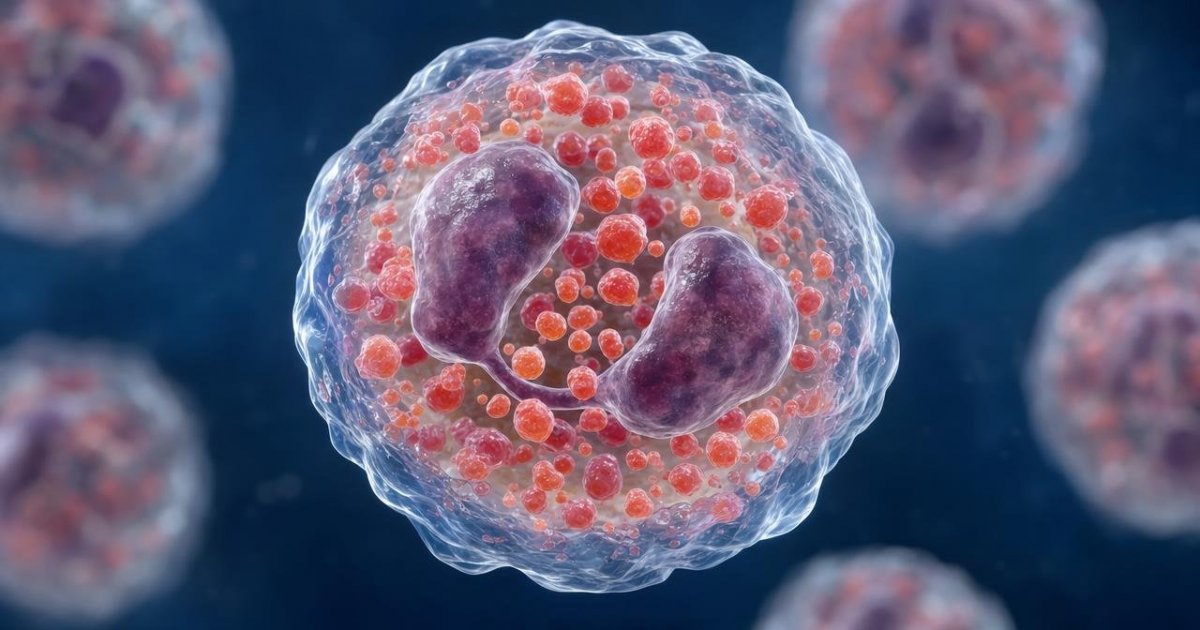
Eosinophils (Eos, Eos %, Eosinophil percentage, Relative eosinophils, Eosinophils (blood differential), EOS% on a CBC)
Eosinophils are white blood cells built for two main jobs: attacking parasites too large for other immune cells to swallow, and driving the inflammation behind allergic reactions. They are made in the bone marrow, circulate in the blood only briefly — a matter of hours — and then settle into tissues, especially the airways, skin, and digestive tract, where most of the body's eosinophils actually live. Under the microscope their granules stain bright red with a dye called eosin, which is how they got their name.
On a lab report, eosinophils appear as part of the white blood cell differential — the breakdown showing what fraction of your white cells each type makes up. In healthy adults they are a small slice, typically less than about 5%, alongside neutrophils, lymphocytes, monocytes, and basophils. Many reports pair this percentage with an absolute eosinophil count in cells per microliter, and when the two seem to disagree, the absolute count is the one that matters clinically.
People usually look this value up after spotting a high flag on routine bloodwork. Most elevations trace back to ordinary things — hay fever, asthma, eczema, a new medication — and a single reading rarely settles anything. What clinicians care about is whether the elevation is real (confirmed by the absolute count), whether it persists on repeat testing, and whether it fits with your symptoms and history.
Reference ranges
Adults
Most US labs consider eosinophils normal at roughly 0–5% of total white blood cells (some report 1–4% or allow up to 6%); these bands follow the common convention that eosinophils make up less than about 5% of circulating white cells, per StatPearls and standard US lab practice.
How to read your result
Low readings, including zero, are the easy case: most reference ranges start at 0%, and low eosinophils rarely signal disease. Corticosteroids like prednisone, acute stress, and active infection all push the number down temporarily, and doctors essentially never treat a low eosinophil percentage on its own.
High readings need one extra step before interpretation: converting the percentage into an absolute count. Because the percentage is relative, it can rise when other white cells fall without any true increase in eosinophils. Once a genuine elevation is confirmed — generally an absolute count above about 500 cells/µL — the likeliest causes are allergic conditions, drug reactions, and (especially after travel) parasitic infections; persistent counts of 1,500 cells/µL or more prompt a broader workup for hypereosinophilic conditions. Trend and persistence matter far more than any single number.
What can shift this value
- Corticosteroid medicines (prednisone and similar) — these sharply and quickly lower eosinophils
- Allergy season and day-to-day allergen exposure, which can raise the level in people with hay fever, asthma, or eczema
- New medications — antibiotics, allopurinol, and anti-seizure drugs are among the most common triggers of drug-related eosinophilia
- Acute illness — active bacterial infections and physical stress temporarily suppress eosinophils, while the recovery phase can bump them up
- Recent travel to tropical or subtropical regions, where parasitic infections that drive eosinophils are more common
- Time of day — eosinophils follow the body's cortisol rhythm, running lower in the morning and higher at night
- Pregnancy, during which eosinophil levels tend to run somewhat lower, with a sharp dip around labor
- Shifts in other white cell types — a surge in neutrophils shrinks the eosinophil percentage (and a drop inflates it) without any real change in eosinophils
- Laboratory variation — reference ranges and counting methods differ slightly between labs, so the same blood can read a few tenths differently
When it's tested
The eosinophil percentage comes with every complete blood count (CBC) that includes a differential — one of the most commonly ordered blood panels and a routine part of annual physicals. It is not included in a CBC without differential, a basic or comprehensive metabolic panel (BMP/CMP), or a lipid panel. Beyond routine screening, clinicians order it when evaluating allergies, asthma, unexplained rashes, suspected drug reactions, digestive symptoms like food sticking, or illness after international travel, and to monitor treatment in eosinophil-driven conditions.
The eosinophil percentage is a unitless proportion and reads the same on lab reports worldwide; the related absolute eosinophil count may appear as cells/µL (or /mm³) on US reports and as ×10⁹/L elsewhere — 500 cells/µL equals 0.5 ×10⁹/L.
Frequently asked questions
Is your value% a normal eosinophil level?
Most US labs consider eosinophils normal at roughly 0–5% of white blood cells, though the exact cutoff varies by laboratory — some ranges top out at 4%, others at 6%. Compare your value against the reference range printed on your own report, and ask your clinician about anything flagged.
What is the difference between eosinophil percentage and absolute eosinophil count?
The percentage tells you what share of your white blood cells are eosinophils; the absolute count tells you how many eosinophil cells are in each microliter of blood. The absolute count is the number doctors actually use — eosinophilia is generally defined as more than about 500 cells/µL. The percentage can look high simply because other white cells dropped, so a flagged percentage is always checked against the absolute count.
Can allergies cause high eosinophils?
Yes — allergic conditions are the most common reason for elevated eosinophils in US adults. Hay fever, asthma, eczema, and chronic hives can all raise the level, and it often tracks with how active the allergies are. Seasonal spikes that settle once the allergen fades are common, which is why clinicians often recheck the value before ordering more testing.
My eosinophils are 0 — should I be worried?
Almost never. Most lab reference ranges for eosinophils start at 0%, so a zero is within normal limits. Corticosteroid medicines like prednisone, acute stress, and active infections all temporarily push eosinophils down. Doctors do not treat a low eosinophil percentage by itself, but it is always fine to ask your clinician to look at the whole CBC with you.
Do high eosinophils mean I have cancer?
Usually not. The common causes of high eosinophils are allergies, asthma, eczema, medication reactions, and parasitic infections. Blood cancers are an uncommon cause that clinicians consider mainly when the absolute count is very high, stays high on repeat testing, and no other explanation is found. A single elevated percentage on one lab report is a reason for follow-up, not a diagnosis.
What should I do about an eosinophil level of your value%?
Where your value falls relative to your lab's printed reference range determines the next step, and the absolute eosinophil count on the same report matters more than the percentage. Bring the result to your clinician, who can put it in context with your symptoms, medicines, and history.
Browse Eosinophils values
All 151 values from 0 to 15 %
- 0.0
- 0.1
- 0.2
- 0.3
- 0.4
- 0.5
- 0.6
- 0.7
- 0.8
- 0.9
- 1.0
- 1.1
- 1.2
- 1.3
- 1.4
- 1.5
- 1.6
- 1.7
- 1.8
- 1.9
- 2.0
- 2.1
- 2.2
- 2.3
- 2.4
- 2.5
- 2.6
- 2.7
- 2.8
- 2.9
- 3.0
- 3.1
- 3.2
- 3.3
- 3.4
- 3.5
- 3.6
- 3.7
- 3.8
- 3.9
- 4.0
- 4.1
- 4.2
- 4.3
- 4.4
- 4.5
- 4.6
- 4.7
- 4.8
- 4.9
- 5.0
- 5.1
- 5.2
- 5.3
- 5.4
- 5.5
- 5.6
- 5.7
- 5.8
- 5.9
- 6.0
- 6.1
- 6.2
- 6.3
- 6.4
- 6.5
- 6.6
- 6.7
- 6.8
- 6.9
- 7.0
- 7.1
- 7.2
- 7.3
- 7.4
- 7.5
- 7.6
- 7.7
- 7.8
- 7.9
- 8.0
- 8.1
- 8.2
- 8.3
- 8.4
- 8.5
- 8.6
- 8.7
- 8.8
- 8.9
- 9.0
- 9.1
- 9.2
- 9.3
- 9.4
- 9.5
- 9.6
- 9.7
- 9.8
- 9.9
- 10.0
- 10.1
- 10.2
- 10.3
- 10.4
- 10.5
- 10.6
- 10.7
- 10.8
- 10.9
- 11.0
- 11.1
- 11.2
- 11.3
- 11.4
- 11.5
- 11.6
- 11.7
- 11.8
- 11.9
- 12.0
- 12.1
- 12.2
- 12.3
- 12.4
- 12.5
- 12.6
- 12.7
- 12.8
- 12.9
- 13.0
- 13.1
- 13.2
- 13.3
- 13.4
- 13.5
- 13.6
- 13.7
- 13.8
- 13.9
- 14.0
- 14.1
- 14.2
- 14.3
- 14.4
- 14.5
- 14.6
- 14.7
- 14.8
- 14.9
- 15.0
Sources
- Blood Differential Test — MedlinePlus (National Library of Medicine)
- Blood differential test — MedlinePlus Medical Encyclopedia
- Eosinophil count - absolute — MedlinePlus Medical Encyclopedia
- Eosinophilia: Causes and definition — Mayo Clinic
- Eosinophilia (StatPearls) — NCBI Bookshelf
Educational information, not medical advice. Full disclaimer