MCHC (Mean corpuscular hemoglobin concentration, Mean cell hemoglobin concentration, Mean corpuscular haemoglobin concentration, MCHC blood test, Hemoglobin concentration per red blood cell)
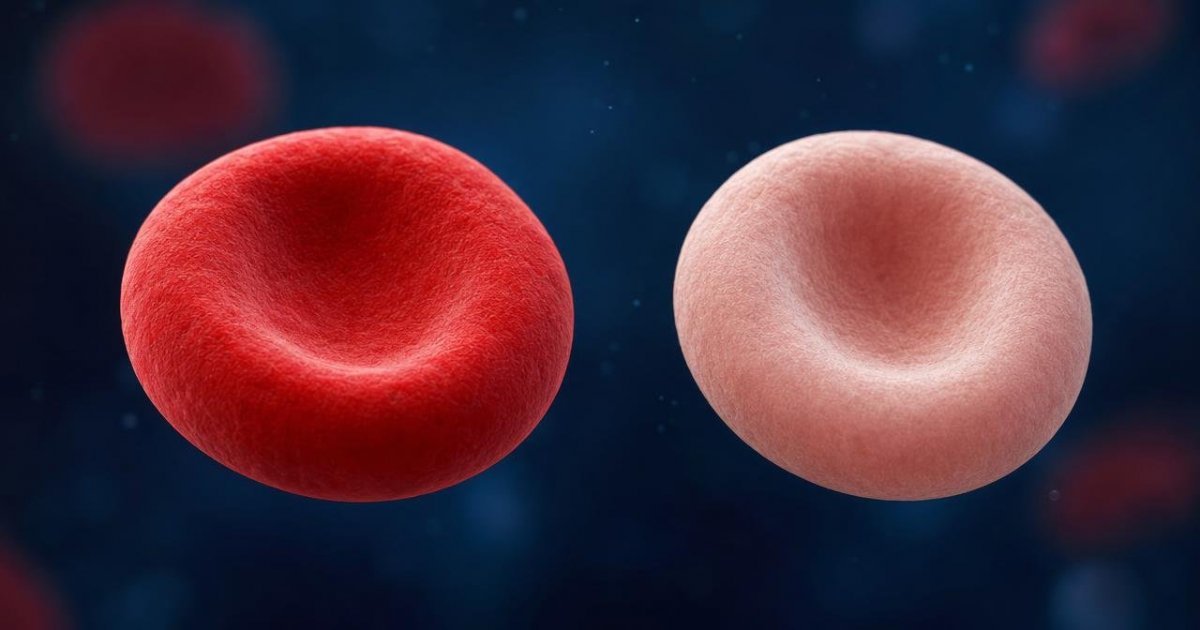
MCHC — mean corpuscular hemoglobin concentration — tells you how densely hemoglobin is packed inside your red blood cells, on average. Hemoglobin is the iron-containing protein that grabs oxygen in your lungs and releases it in your tissues, and each red cell is essentially a flexible bag built to carry it. MCHC answers a simple question about those bags: relative to their size, how full are they? A normal result means your red cells are properly loaded; a low result means they are running pale and under-filled; a high result — which is rare — means they appear more concentrated than red cells usually get.
The lab doesn't measure MCHC directly. It calculates it by dividing your hemoglobin by your hematocrit (the fraction of your blood made up of red cells). That arithmetic detail matters more than it sounds: anything that throws off either ingredient — a fatty blood sample, unusual antibodies, or cells damaged during the draw — throws off MCHC too. It's part of why doctors treat surprising MCHC values, especially high ones, with a healthy dose of skepticism until a repeat test confirms them.
MCHC arrives automatically with every complete blood count as one of the red blood cell indices, alongside MCV (cell size), MCH (hemoglobin per cell), and RDW (variation in cell size). Its main job is to help classify anemia. When hemoglobin is low, MCHC helps answer the follow-up question — is the problem too little hemoglobin being made per cell (pointing toward iron deficiency or thalassemia), or something else entirely?
Reference ranges
Adults
Most US labs consider roughly 32 to 36 g/dL normal for adult MCHC, following the convention cited by MedlinePlus, though your lab's printed range may differ slightly. There is no standard 'panic' cutoff for MCHC itself — with very abnormal values, the accompanying hemoglobin determines true urgency.
How to read your result
Reading MCHC starts with the reference range — typically 32 to 36 g/dL for adults — and then, immediately, with the rest of the CBC. A low MCHC (hypochromia) most often travels with small red cells and points toward iron deficiency or thalassemia trait; the lower it goes, the more established the process usually is, and values far below 30 usually mean an advanced anemia that deserves prompt attention. But MCHC almost never diagnoses anything alone: iron studies, MCV, and your history do the heavy lifting.
High MCHC works differently. Because a red cell can only physically hold so much hemoglobin, values much above 36–37 g/dL are biologically suspect. The first explanation to rule out is a measurement artifact — cold agglutinins, fatty blood, or hemolysis in the tube. Genuinely high values usually mean the red cells are abnormally round and dense, as in hereditary spherocytosis, or are being destroyed, as in autoimmune hemolytic anemia. So the practical rule of thumb: a low MCHC prompts a search for the cause; a high MCHC prompts, first, a repeat test.
What can shift this value
- Iron intake and iron stores — the single biggest driver of a low MCHC
- Blood loss, including heavy menstrual periods, gastrointestinal bleeding, and frequent blood donation
- Inherited red-cell conditions — thalassemia trait lowers MCHC, hereditary spherocytosis raises it
- Pregnancy, which sharply raises iron demand — if iron stores run down, MCHC can drift lower
- High blood fats (lipemia) after a fatty meal or with elevated triglycerides, which can falsely raise the result
- Cold agglutinins — antibodies that clump red cells in cooler temperatures and produce a falsely high reading
- Sample handling — red cells that rupture in the collection tube falsely raise MCHC
- Delays between blood draw and analysis — red cells swell in stored samples, which can falsely lower the calculated MCHC
- Chronic inflammation or long-term illness, which can gradually lower it
- Analyzer and lab differences — because MCHC is calculated, small systematic differences between laboratories are normal
When it's tested
MCHC is included in every complete blood count (CBC), where it appears among the red blood cell indices next to MCV, MCH, and RDW. That means you'll see it whenever a CBC is ordered: routine annual physicals, anemia workups, pre-surgical testing, pregnancy care, and monitoring of chronic conditions or medications that affect blood counts. It is not part of a comprehensive metabolic panel (CMP) or a lipid panel — if your printout lacks an MCHC, you likely didn't have a CBC drawn.
US labs report MCHC in g/dL; to convert to the g/L used in many other countries, multiply by 10 — so {value} {unit} is the same as {si_value} {si_unit}.
Frequently asked questions
Is your value a normal MCHC level?
Most US labs consider an adult MCHC of about 32 to 36 g/dL normal. Where your value falls relative to that range — and relative to your own past results — determines whether it needs any follow-up. Your lab's printed reference range may differ slightly, so check the report itself.
What does a low MCHC mean?
A low MCHC means your red blood cells contain a lower-than-normal concentration of hemoglobin, making them look pale under a microscope — doctors call this hypochromia. The most common cause by far is iron deficiency; inherited conditions such as thalassemia trait and long-term inflammation are other frequent explanations. Your clinician will read it alongside hemoglobin, MCV, and often iron studies to pin down the cause.
What causes a high MCHC?
Genuinely high MCHC is uncommon because red cells have a physical limit on how much hemoglobin they can hold. When it is real, the usual causes are hereditary spherocytosis (round, dense red cells) and autoimmune hemolytic anemia (red cells being destroyed). Just as often, though, a high reading is a sample artifact — cold agglutinin antibodies, fatty blood, or cells that broke apart in the tube — which is why labs frequently recheck before anyone treats the number as real.
Can diet or iron pills fix a low MCHC?
Only if low iron is actually the cause — and that's a real 'if.' When iron deficiency is confirmed, iron-rich foods and supplements prescribed by your clinician usually normalize MCHC over a few months. But if the cause is thalassemia trait, extra iron won't help and can even be harmful, and if the iron deficiency comes from hidden blood loss, the bleeding source needs finding. Get iron studies done before starting supplements, and take them under a clinician's guidance.
Do I need to worry about an MCHC of your value?
MCHC is one clue among many on a CBC, and no single value of it constitutes an emergency on its own. What matters is how far it sits from the 32–36 g/dL range, whether it's changing over time, and what your hemoglobin and other results show. Bring the full report to your clinician for an interpretation in context.
What is the difference between MCHC, MCH, and hemoglobin?
Hemoglobin is the total amount of the oxygen-carrying protein in your blood — the headline anemia number. MCH is the average amount (weight) of hemoglobin inside a single red cell, while MCHC is the average concentration — how tightly that hemoglobin is packed relative to the cell's size. Two people can have identical hemoglobin but different MCHC values if their red cells differ in size and density, which is exactly why doctors use these indices to sort out what type of anemia is present.
Browse MCHC values
All 141 values from 24 to 38 g/dL
- 24.0
- 24.1
- 24.2
- 24.3
- 24.4
- 24.5
- 24.6
- 24.7
- 24.8
- 24.9
- 25.0
- 25.1
- 25.2
- 25.3
- 25.4
- 25.5
- 25.6
- 25.7
- 25.8
- 25.9
- 26.0
- 26.1
- 26.2
- 26.3
- 26.4
- 26.5
- 26.6
- 26.7
- 26.8
- 26.9
- 27.0
- 27.1
- 27.2
- 27.3
- 27.4
- 27.5
- 27.6
- 27.7
- 27.8
- 27.9
- 28.0
- 28.1
- 28.2
- 28.3
- 28.4
- 28.5
- 28.6
- 28.7
- 28.8
- 28.9
- 29.0
- 29.1
- 29.2
- 29.3
- 29.4
- 29.5
- 29.6
- 29.7
- 29.8
- 29.9
- 30.0
- 30.1
- 30.2
- 30.3
- 30.4
- 30.5
- 30.6
- 30.7
- 30.8
- 30.9
- 31.0
- 31.1
- 31.2
- 31.3
- 31.4
- 31.5
- 31.6
- 31.7
- 31.8
- 31.9
- 32.0
- 32.1
- 32.2
- 32.3
- 32.4
- 32.5
- 32.6
- 32.7
- 32.8
- 32.9
- 33.0
- 33.1
- 33.2
- 33.3
- 33.4
- 33.5
- 33.6
- 33.7
- 33.8
- 33.9
- 34.0
- 34.1
- 34.2
- 34.3
- 34.4
- 34.5
- 34.6
- 34.7
- 34.8
- 34.9
- 35.0
- 35.1
- 35.2
- 35.3
- 35.4
- 35.5
- 35.6
- 35.7
- 35.8
- 35.9
- 36.0
- 36.1
- 36.2
- 36.3
- 36.4
- 36.5
- 36.6
- 36.7
- 36.8
- 36.9
- 37.0
- 37.1
- 37.2
- 37.3
- 37.4
- 37.5
- 37.6
- 37.7
- 37.8
- 37.9
- 38.0
Sources
- Red Blood Cell (RBC) Indices — MedlinePlus (National Library of Medicine)
- RBC indices — MedlinePlus Medical Encyclopedia
- Complete blood count (CBC) — Mayo Clinic
- Normal and Abnormal Complete Blood Count With Differential — StatPearls, NCBI Bookshelf
Educational information, not medical advice. Full disclaimer