MCV (Mean corpuscular volume, Mean cell volume, Average red blood cell size, MCV blood test, Red blood cell size test)
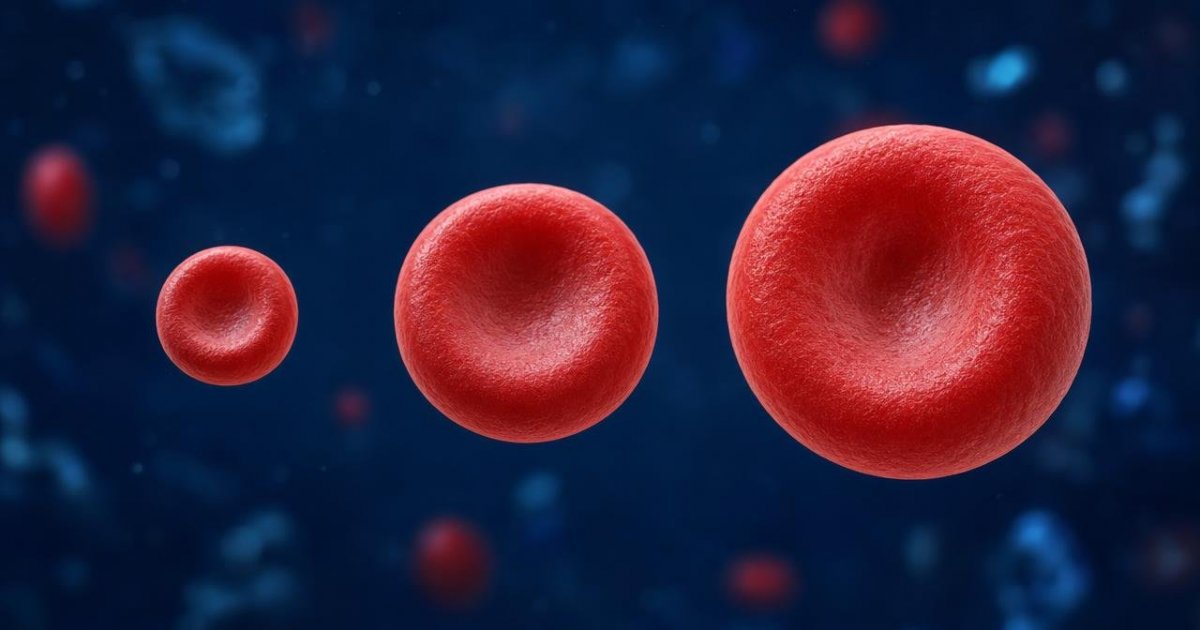
MCV (mean corpuscular volume) tells you the average size of your red blood cells, measured in femtoliters (fL). Red blood cells carry oxygen from your lungs to every tissue in your body, and their size says a lot about how they were built. When the bone marrow lacks iron, it produces small cells; when it lacks vitamin B12 or folate, or is affected by alcohol, thyroid, or liver problems, it produces large ones. That simple principle makes MCV one of the hardest-working numbers on a blood count.
MCV appears automatically on every complete blood count (CBC), alongside hemoglobin, hematocrit, and the other red cell indices (MCH, MCHC, RDW). Doctors lean on it most when anemia is present, because it splits the possible causes into three manageable groups: microcytic (small cells, under about 80 fL — think iron deficiency and thalassemia), normocytic (normal-sized cells, 80–100 fL — think blood loss, kidney disease, chronic illness), and macrocytic (large cells, over 100 fL — think B12 or folate deficiency, alcohol, medications).
One caveat worth knowing: MCV is an average. If your blood contains a mix of unusually small and unusually large cells, they can average out to a deceptively normal number. The RDW value on the same report measures how varied your cell sizes are and helps catch that situation. MCV also changes slowly — red cells live about 120 days — so today's number reflects conditions over the past few months, not the past few days.
Reference ranges
Adults
Most US labs consider roughly 80 to 100 fL a normal adult MCV for both men and women, following the convention used by StatPearls and most US laboratories; exact cutoffs vary slightly by laboratory.
How to read your result
Start with the reference range on your own report, since labs differ slightly; 80–100 fL is the common convention. A low MCV means small red cells and points first to iron deficiency (usually confirmed with a ferritin test) or thalassemia trait (an inherited, often harmless condition suggested by a low MCV with a normal or high red cell count). A high MCV means large red cells and points first to vitamin B12 or folate deficiency, alcohol use, hypothyroidism, liver disease, or medications.
How far from range matters: a few fL past the cutoff is frequently benign variation, while values in the 60s or above 115 fL almost always have an identifiable cause and deserve a timely — not panicked — workup. Always read MCV together with hemoglobin (is there actually anemia?) and RDW (is cell size uniform or mixed?), and weigh the trend across old results more heavily than any single number.
What can shift this value
- Iron stores — low iron shrinks new red cells over weeks to months
- Vitamin B12 and folate status — deficiency enlarges new red cells
- Alcohol intake — regular use raises MCV even without anemia
- Medications — hydroxyurea, zidovudine, methotrexate, anticonvulsants, and long-term metformin (via B12) raise it; the effect fades after stopping
- Thyroid function — hypothyroidism nudges MCV up
- Liver disease — alters red cell membranes and raises MCV
- Reticulocytes — a surge of young (larger) red cells after bleeding or hemolysis temporarily raises the average
- Recent blood transfusion — the result reflects donor cells mixed with yours
- Pregnancy — MCV normally rises slightly
- Lab variation and artifacts — different analyzers read a few fL apart, and cold agglutinins or very high blood sugar can falsely raise the reading
When it's tested
MCV is included automatically in every complete blood count (CBC), one of the most commonly ordered blood tests — at routine physicals, before surgery, during pregnancy care, and whenever anemia, fatigue, or bleeding is being evaluated. You will not find it on a basic or comprehensive metabolic panel (BMP/CMP) or a lipid panel; those measure chemistry, not blood cells. No fasting or special preparation is needed for the MCV itself.
MCV is reported in femtoliters (fL) in the US, the UK, and Singapore alike — there is no SI conversion to do; older reports sometimes print µm³ (cubic micrometers), which is numerically identical to fL.
Frequently asked questions
Is your value fL a normal MCV level?
Most US labs consider roughly 80 to 100 fL a normal adult MCV, for both men and women. Exact cutoffs vary slightly by lab, so check the reference range printed on your own report.
What does a low MCV mean?
A low MCV (microcytosis) means your red blood cells are smaller than normal. The two most common causes are iron deficiency — often from blood loss — and thalassemia trait, an inherited condition that is usually harmless but runs in families. Iron studies (especially ferritin) usually separate the two. Because red cells live about 120 days, a low MCV reflects something that has been going on for a while.
What does a high MCV mean?
A high MCV (macrocytosis) means your red blood cells are larger than normal. Common causes include vitamin B12 or folate deficiency, regular alcohol use, liver disease, an underactive thyroid, and several medications. Mild elevations are often benign, but a persistently or clearly high MCV deserves a workup — mainly to rule out B12 deficiency, which can affect nerves if untreated.
Can my MCV be abnormal even if I'm not anemic?
Yes. MCV describes red cell size, not red cell quantity, so it can drift out of range while your hemoglobin is still normal. A low MCV without anemia is common in thalassemia trait and early iron deficiency; a high MCV without anemia often comes from alcohol, medications, or early B12/folate shortfall. An abnormal MCV with normal hemoglobin is often an early clue worth a simple follow-up rather than a cause for alarm.
Does drinking alcohol raise MCV?
Yes — regular alcohol use is one of the most common causes of a mildly elevated MCV, even without anemia and even before the liver shows any trouble. The effect comes both from alcohol's direct action on the bone marrow and from the folate deficiency that can accompany heavy drinking. The MCV typically drifts back toward normal over two to four months after cutting back, since that is how long it takes to replace the red cell population.
Should I worry about an MCV of your value fL?
MCV is a clue, not a diagnosis, and it has no true emergency values by itself. The right response depends on how far from the 80–100 fL range you are, your hemoglobin, and how you feel — your clinician can put it in context.
Browse MCV values
Sources
- MCV (Mean Corpuscular Volume) — MedlinePlus, National Library of Medicine
- Red Blood Cell (RBC) Indices — MedlinePlus, National Library of Medicine
- Mean Corpuscular Volume (StatPearls) — NCBI Bookshelf, National Library of Medicine
- Complete blood count (CBC) — Mayo Clinic
Educational information, not medical advice. Full disclaimer